 |
marcio montarroyos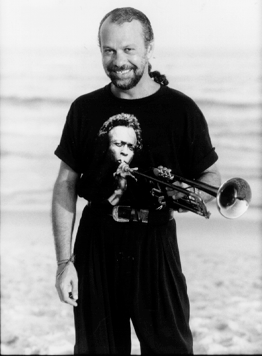 Says
Marcio Montarroyos of his music: Says
Marcio Montarroyos of his music:Marcio Montarroyos started his musical studies on classical piano at age four in his native Rio de Janeiro. His early training continued at Rio's National School of Music where he focused on classical theory, harmony and composition. After a decade of classical studies, Montarroyos heard Dizzy Gillespie perform and he began to gravitate towards jazz. By age 20, Montarroyos was playing with the house band at Rio's famous Club Number One where he accompanied luminaries such as Stevie Wonder, Sarah Vaughn, Nancy Wilson, Carols Santana and Ella Fitzgerald. He then received a scholarship to Berklee School of Music in Boston and attended until 1973. Five years later, he received a four–star rating from Downbeat magazine and won their accolades for his precise and passionate playing on his own recording, Stone Alliance. In 1979 Eckart Rahn discovered Marcio Montarroyos at a concert in Rio de Janeiro. Rahn produced Marcio's first international releases Magic Moment and Carioca for Columbia Records in New York. Jay Levy of Lorimar Productions was instrumental in getting Marcio signed to then–Columbia Records as the first–ever Brazilian artist. Most of the tracks on these two vinyl albums were reissued in 1995 as Samba Solstice (15001-2) on Black Sun Music; actually, the Black Sun label was initially formed with the Celestial Harmonies structure to accommodate Marcio's music which was thought to be incompatible with the musical styles represented on Celestial Harmonies itself. In 1993, Marcio's second recording for Black Sun Music, Terra Mater (15004-2) was released. A track, Our Saint of Rosary, from a forthcoming and yet untitled recording opens the world music sampler The New Feeling: An Anthology of World Music (13124-2) which Jaslyn Hall of the Australian ABC compiled in 1996. Marcio Montarroyos' broad mastery of an array of musical styles—jazz, Brazilian folk, African percussion rhythm, American funk and classical melody—has earned him wide recognition as a uniquely contemporary player and composer with deep multi–cultural roots. He died on December 12, 2007, of lung cancer. discography"...There is a palpable interpersonal commitment respect and trust in both ensembles and improvisation...the playing is precise and passionate." BERG - DownBeat/USA"Marcio constroí um som encantadoramente brasileiro com acentuaccedião funk irresistíl...consegue amalgamar o ritmo brasileiro com uma atividade a nível internacional." João Marcos Coelho/Revista Visão "-Marcio Montarroyos ist einer der meistgeschatzien chatzten musiker brasiliens." Revista do jazz Fest Berlin - 1982 "-Marcio está perparado para enfrentar platéias de qualquer canto do mundo...um artigo tip exportacão para qualquer mercado." Zuza Homem de Melo/O Estado de São Paulo "-Um expoente no seu instrumento, um músico admirável mesmo fora do Brasil." Zuza Homem de Melo |
 |