the education digest
August 20, 2002
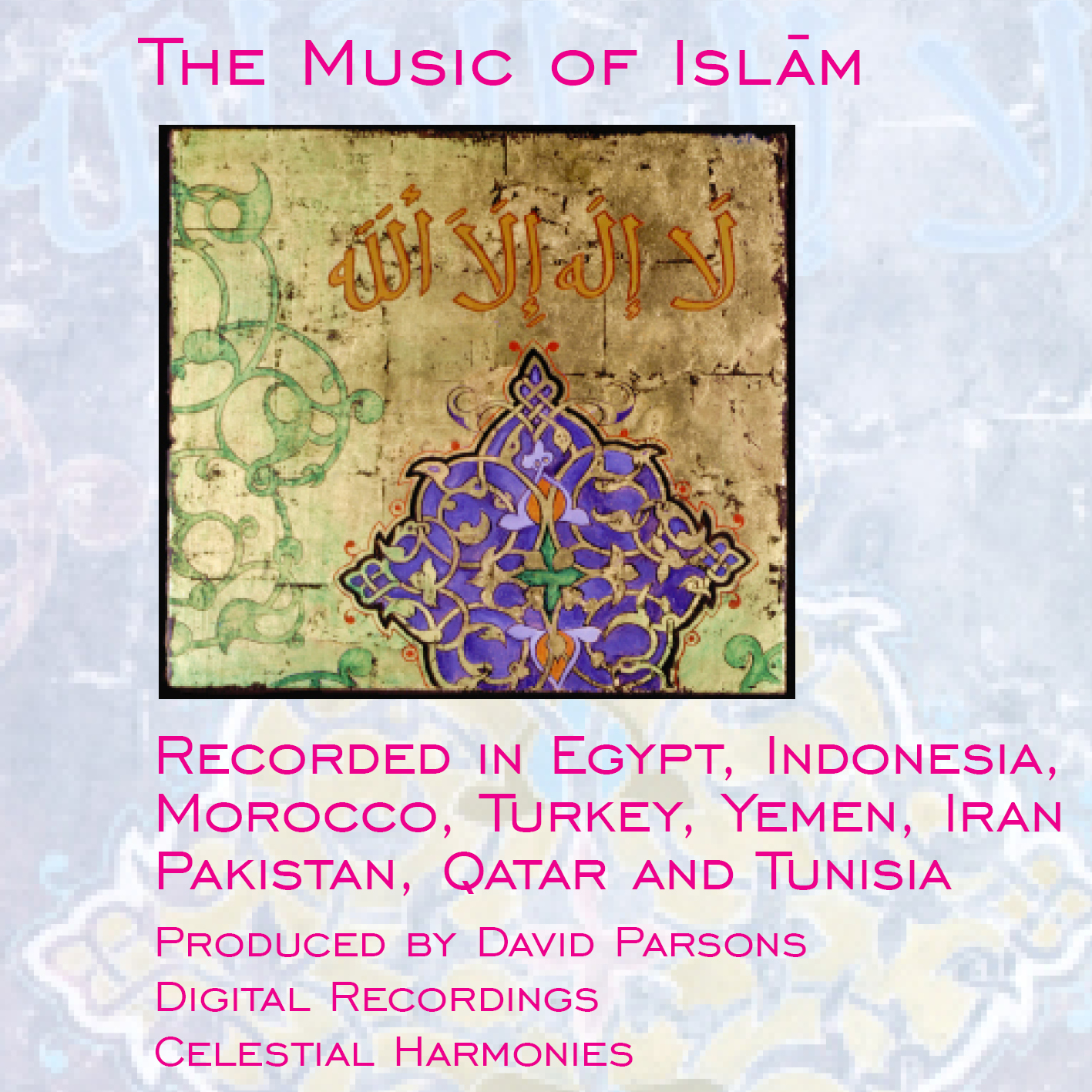
 13159 THE MUSIC OF ISLAM
(SAMPLER) - VARIOUS ARTISTS (1998
AFIM INDIE Award Winner)
13159 THE MUSIC OF ISLAM
(SAMPLER) - VARIOUS ARTISTS (1998
AFIM INDIE Award Winner)
Given the number of Islamic-majority countries in the world, and the
number of centuries they’ve been that way, the variety, prevalence,
and quality of Islamic music as part of the cultural histories of those
places should come as no surprise. The Music of Islam features 15 tracks
totally nearly 80 minutes of music from the huge 15-volume survey that
producer David Parsons compiled. Each volume (and each selection on
this sampler) represents a different Islamic musical tradition: the
music of Andalusia, the Arabian Peninsula, Indonesia, Iran, Pakistan,
Tunisia, and Yemen; classical music of Cairo; music of the Nubians,
the South Sinai Bedouins, and the Whirling Dervishes; gnawa music and
the music of mystics; Sufi ceremonies; and Koran recitations.
What the various musics tend to share in common is a 24-tone-per-octave
system, using modal scales. (Western music recognizes 12 tones per octave,
and uses major and minor scales). There are numerous compositional forms,
with strict rules governing improvisation, structure, and permissible
variations. The songs are likewise played on a wide variety of percussion,
wind, and stringed instruments (rarely bowed) uncommon to Western music.
The line between secular and sacred, folk and art music is practically
arbitrary.
David Parsons has captured beautiful performances of instrumental and
sung music, travelling to Egypt, Indonesia, Iran, Morocco, Pakistan,
Qatar, Tunisia, Turkey, and Yemen to do so. While the 15-volume set
would, of course, be the ideal gem in a personal or library collection,
The Music of Islam sampler is an excellent, excellent introduction to
the wonderful diversity of Islamic music. Highly recommended.
- Tom Bowden is Contributing Review Editor to The Education Digest
and Managing Editor of Tech Directions.
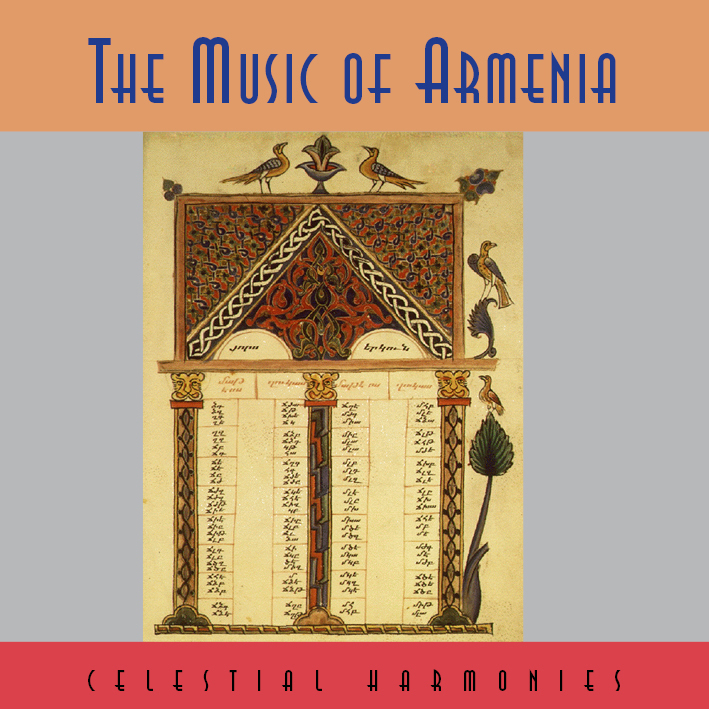
13111 THE
MUSIC OF ARMENIA (SAMPLER) - VARIOUS ARTISTS
The 21 cuts on this CD, which lasts nearly and hour and twenty minutes,
form a quick survey of the rich diversity and history of Armenian music:
sacred choral music, medieval music, traditional kanon (zither) music,
folk music, and songs for the duduk (a type of oboe, producing a sound
most typically identifiable as “Armenian”). The songs here
reach as far back as the 12th century and extend up to the 20th century.
(Armenia has some of the world’s oldest written music.) All of
the music here comes from a six-volume set, each volume devoted to a
particular type of Armenian music.
Recorded by the intrepid David Parsons, responsible for the three-volume
Music of Cambodia, the three-volume Music of Vietnam, and 15-volume
(!) Music of Islam, the selections comprising The Music of Armenia come
mainly from areas within Armenia’s present borders, with the exception
of folk music from the Nagorno-Karabakh region, which now lies inside
Azerbaijan.
Armenia’s sacred choral music has its roots in both chant and
epic-song traditions and demonstrates a sophisticated—and disarmingly
beautiful—sense of harmony. How a full CD of this music never became
as big a seller as the Benedictine monk’s Chant is beyond me. Mesmerizing,
engaging, and emotionally compelling, the three sacred songs represented
here are amazing examples of lyrics whose message you can feel, even
if you don’t understand the language.
Closely related as a musical genre are the next four songs, from medieval
Armenia, known as Sharakan songs, which blend sacred figures with sacred
themes and focus more on solo rather than ensemble performances. This
is music to break your heart.
Highlighting the next six cuts are the duduk and kanon,
representing the classical music of Armenia, which nonetheless bears
a close resemblance to its folk music. Stately, austere, and gentle,
the songs convey a subtle majesty and dignity.
The last nine tracks document Armenia’s folk musics, including
dances, love songs, songs of praise, and a pair of laments. The Karabakh
Children’s Choir, who perform Kenats yerg, deserve a CD
of their own, so good is their singing.
If you’re new to world or Armenian music and want a sample of
what’s available, The Music of Armenia is a must-have to start
your collection. Otherwise, the full six-CD set is what you want.
- Tom Bowden is Contributing Review Editor to The Education Digest
and Managing Editor of Tech Directions.
|