folk federation journal, new south wales
December, 2000
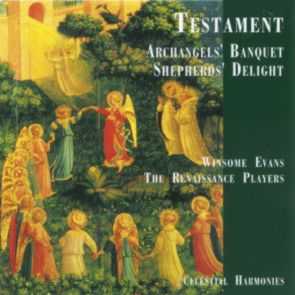
 14197 TESTAMENT:
ARCHANGELS' BANQUET / SHEPHERDS' DELIGHT (2 CD) - WINSOME EVANS AND
THE RENAISSANCE PLAYERS
14197 TESTAMENT:
ARCHANGELS' BANQUET / SHEPHERDS' DELIGHT (2 CD) - WINSOME EVANS AND
THE RENAISSANCE PLAYERS
I should perhaps begin by stating that I'm not strictly an impartial
reviewer here. I've been a Renaissance Player before and, after hearing
this two CD set, I wish I still was. Sprawling across two CDs, Winsome
Evans has sculpted a programme that (providing you have functioning
ears and like good music) is sure to engage and delight. Winsome's the
kind of musical director who enjoys drawing links between seemingly
disparate musics and traditions. Her instrumental arrangements, for
example, owe more to the similarly catholic approaches of Thomas Binkley
and David Munrow (who delved into the folk traditions of north Africa,
Spain and west Asia in their interpretations of early music), than to
the ascetic stringency of Christopher Page and the current crop of "less–is–more"
directors of early music ensembles. For Winsome, music is, most definitely,
more.
The instrumental colours are varied and mostly well–suited to
the songs—(I wasn't convinced by the bowed diwan saz [a
long–necked Turkish flute] accompanying the Wexford carol). Scattered
throughout these discs we hear wood flutes, gemshorn, harp, harpsichord,
mandolin and mandora, chitarra moresca (a plucked string instrument
originating with the Moors), gadulka (a Bulgarian fiddle), rebec,
baroque viola and cello, and a good deal more. Many of these Winsome
plays herself, always with consummate proficiency. Her harp playing,
in particular, is inventive, connecting fluidly with the phrasing of
the voices and the instruments it accompanies. The rest of the instrumental
band are equally inspired, though special mention should go to Sally
Treloyn on flutes (listen to The darkest midnight, for example),
and Michael Hooper on mandolin and mandora.
In geographical terms the ground covered is immense: the repertoire
originates from the United States in the west (a couple of African-American
spirituals), to Greece in the east (The dance of zalongou, sung
by Mina Kanaridis, is gorgeous and worth the price of the disk alone);
and from Finland in the north (an arrangement and performance of Gaudete
that knocks Maddy Prior and her mates out cold), to Spain in the south
(a typically exuberant and boisterous setting of a traditional Spanish
choir, De las montañas venimos). The point of all this
travel is to demonstrate the "connective aspects of angels (the
celestial), shepherds (the terrestrial), and dancing circles (in the
structures and arrangements of music and poetry, in dance formations,
and so on)...the offerings constitute a sort of aural banquet".
As is probably apparent from the quote above, the CD liner notes (and
this is always the case with a Winsome Evans release) are exemplary.
There is so much information here (ranging from profundity to incidental
trivia), that it could easily form the basis of a full tome. It is well–written
and lucid, and while the scholarship is readily apparent it's never
dull—Winsome's tongue seems to spend considerable time lodged adjacent
to her cheek. The humour extends to the performances as well—Winsome's
arrangements for harpsichord, the occasional title (Jesus' disco
caper, indeed), Krysia Mansfield and Simon Lobelson's singing—not
all of it, admittedly to my taste. I confess, too, to a disliking to
some of the vocal sounds—my preference is for the lighter, agile
voices (Mina Kanaridis is perfect in this respect), than for the heavier,
trained–sounding voices which tend to labour the ornamentation
and occasionally stray pitchwise from the centre of the note.
While the discs feature musicality aplenty in the performances of the
Players, the relative success or failure of the project rests squarely
on the shoulders of Winsome Evans. She doesn't disappoint. Her compositional
contributions to the texts without recorded melodies are both appropriate
and memorable (the musical setting for the evocative, Lulllay mun
lykyng, certainly matches it with a text that has been described
as the masterpiece of the lullaby carols'). Her arrangements, her playing,
and perhaps most of all, her vision for the collection are similarly
well–wrought: Testament is a small gesture against scientific
technological and economic "advances" as a reminder of what
the human imagination has been able to accomplish in the past and continues
to so untrammelled by "advances" in a simple environment of
hope and belief. A Luddite manifesto may feel anachronistic as I techo–post
this e-mail review to the editor, but a paean to the achievements of
the human imagination is a welcome sound to my ears.
|