November 13, 2002
Ethnomusicology is a dirty word
ETHNOMUSICOLOGY is a dirty word in music producer Eckart Rahn's book.
The founder of the 35-year-old independent recording label Celestial
Harmonies argues forcefully against the division beween musicology and
ethnomusicology.
``I find that a downright degrading difference. That brief slot in history
of Western classical music that's barely more than 300 years -- to call
that classical and the rest of it alternative is simply wrong,'' he
says.
``That 95 per cent of the world's population whose music goes back thousands
of years, to call that alternative culture even though it's much bigger
and much older is culturally derogatory.''
Rahn has spent his life going beyond borders and sending his team of
musicologists to the remotest reaches to gather classical sounds in
his quest for global understanding.
One of his team of musicologists, New Zealand's David Parsons, who has
produced 50 CDs for Celestial Harmonies, has been robbed twice, been
violently ill and has at times feared for his life.
Another musicologist, Melbourne lecturer Dr Margaret Kartomi, has jumped
through hoops to bring us music from Timor and Indonesia.
``It might sound a bit pompous . . . but music without politics is indulgence.
All great art does have social and political implications,'' Rahn says
on a visit to Melbourne.
German-born Rahn, who has gathered music from Armenia to Australia,
was a high-school dropout when he made his first recording at 22.
``I needed 5000 marks, so I went to every friend's house in Cologne
and borrowed 20-50 marks from each one of them to record Swinging Macedonia,''
he says of the album from which SBS has plucked a piece for a newly
released double.
Rahn, who has recorded more than 40 CDs in Australia alone in the past
decade or so, remembers some of the experiences that have made it all
worthwhile.
One was in 1974 Bayreuth, where Tristan and Isolde left him speechless.
``I walked all night through the little town of Bayreuth thinking I
would never have to eat or sleep again!'' he says.
Another was at the old Five Spot Cafe in New York, when he stayed awake
all night.
At times Eckart finds himself listening to music in his head. Like a
traveller who recalls images, he remembers music and its essence.
``I practically never play music frivolously,'' he says. ``So if I go
to a place where there is background music, I can find it downright
offensive.
``The more you live in silence, the more you will get out of music.''
World music from Celestial Harmonies is available in stores.
February 7, 2000
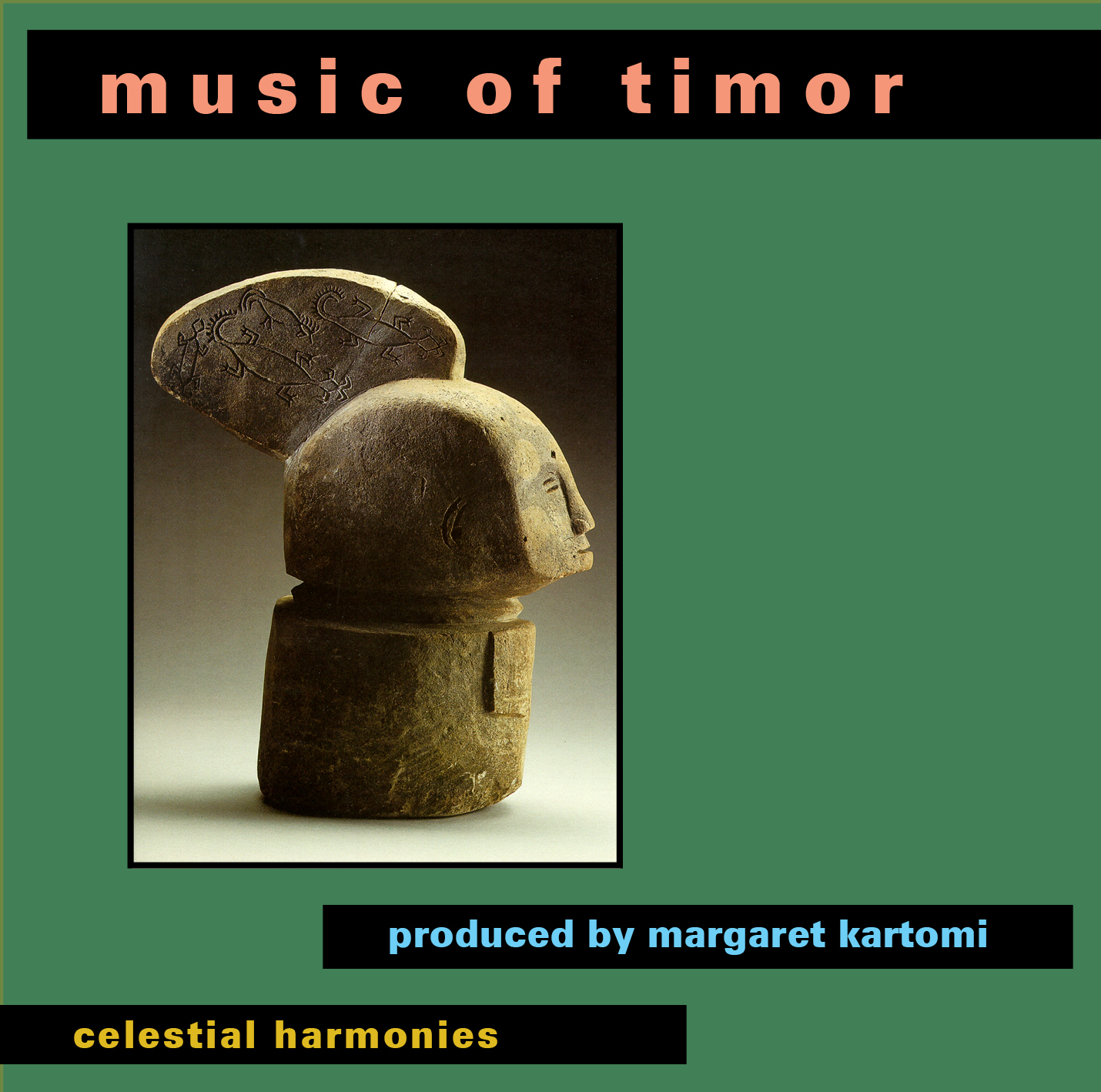
 13182 MUSIC OF TIMOR - VARIOUS
ARTISTS
13182 MUSIC OF TIMOR - VARIOUS
ARTISTS
Scaling mountains under threat of mudslides and crossing rapids in
an electrical storm are all in a day's work for Prof. Margaret Kartomi,
the mild-mannered head of Monash University's school of music.
There is no mountain high enough or river deep enough to keep her from
her quest to collect the music of Timor. With her Indonesian husband-an
engineer who has mastered the electronics of recording in remote places-she
has traveled to Timor more than 40 times in 30 years.
She goes from village to village, organizing performances, capturing
the nuances of sound and adding to her collection, which she believes
is the world's largest. "We've been to some extremely isolated and very
dangerous places-places where they had never seen a white person and
thought I was albino," Kartomi says.
She has just released a CD, The Music of Timor, the fourth in a series
that will eventually include all 26 provinces. She says the CD reflects
the region's vast musical range, from gongs and kettle drums of the
central provinces to the bamboo sasando, a plucked zither, of the west.
The music is the result of thousands of years of tradition as well as
more recent Dutch and Christian influences
Kartomi's aim is to ensure the music doesn't become extinct. "The musical
culture is dying too fast and being replaced by western culture. Parts
of it are dying so fast that the next generation of Timorese composers
will have no tradition and will have only this music as a reference."
Kartomi says that while the Timor CD is timely, it does not have political
overtones. "I hope the musical tradition will still be intact after
the fighting. Otherwise this will be a testimony to a vanished world.
The people might be poor, but their music is rich. They have a beautiful,
ancient culture."
|