scene: london's new arts entertainment weekly
May 1-May 8, 1997
Terrestrial Adventures on Celestial Harmonies
 19909
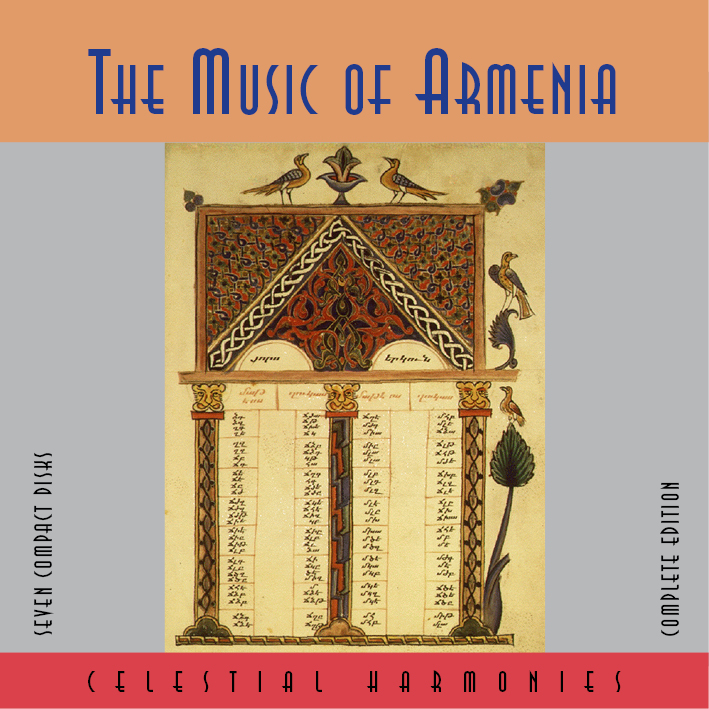
THE MUSIC OF ARMENIA (7 CD BOXED SET) - VARIOUS
ARTISTS
19909
THE MUSIC OF ARMENIA (7 CD BOXED SET) - VARIOUS
ARTISTS
Over the past number of years, the Celestial Harmonies record label
and its affiliates have covered a lot of ground. One of the many impressive
areas of focus, however, has been the label's dedication to the collection
and diffusion of traditional music of various world cultures.
At the start of this century, most people were unable to dedicate large
sums of money and chunks of time to traveling to exotic locations to
absorb exotic cultural traditions. It has really been the advent of
affordable air travel, combined with portable recording equipment and
high fidelity audio systems, that has brought such cultural experiences
to the living rooms of the average person.
During an assignment to collect and compile a set of recordings for
The Music of Islam, New Zealand composer and musicologist David
Parsons had his attention diverted to the culture of Armenia. He soon
realized that little, if any of this music had been properly documented.
So, with blessings from record label owner Eckart Rahn and recording
equipment in hand, Parsons set out to compile the varied musical traditions
of Armenia. The resultant recordings in The Music of Armenia
series have been issued over the past eighteen months in six volumes
encompassing seven discs of material. The series is now also available
as a single–box set as well.
The first volume, Sacred Choral Music, features the talents
of the Echmiadzin Cathedral Choir under the direction of Mihran Ghazellan.
Those listeners familiar with the sound of a Gregorian Chant may quickly
grow accustomed to this lush sound. The music is written in a "monophonic"
style (i.e. all voices singing the same notes in unison), but the addition
of drones bring a thickness to the sound.
Sharakan / Medieval Music is the title of the second volume.
Here, the Shakaran Early Music Ensemble performs music from the Middle
Ages, starting at a point around the fifth century. While the music
is quite obviously medieval in nature, the ancient Armenian tradition
gives it a further exotic quality.
Volume Three, Duduk, features the sound of this flute/recorder–style
instrument. Virtuoso Gevorg Dabagian is the featured soloist, with two
other duduk players and a percussionist in the ensemble. Again, the
effect is haunting and other–worldly in nature.
Many cultures have an instrument in their musical vocabulary which
is based around the zither. In the fourth volume of the series, Kanon
/Traditional Zither Music, the Armenian version of the instrument
is featured. As with other cultures, the kanon can be plucked like a
harp or struck like a percussion instrument. This is one of the instruments
which links the cultural sound of such diverse places as the Orient
or Scandinavia.
As could be expected, an exploration of a country's folk music would
take the longest time. Therefore it's not surprising the Volume Five,
Folk Music, performed by the Shoghaken Ensemble, would fill two
disks by itself. Over the course of this set, the similarities and differences
to other musics are well demonstrated.
The concluding volume of the set, Nagorno–Karabakh, has
a wide assortment of musical endeavors, from vocal folk music to choral
works to instrumental pieces. All these works are performed by amateur
musicians, but that is certainly not evidenced in the quality of the
music.
For the world music traveler, this latest collection of traditional
recordings from Armenia would make an excellent investment—either
in individual volumes or as a complete set.
|