December 17, 1999
"Music of Islam" Set More than Just Songs
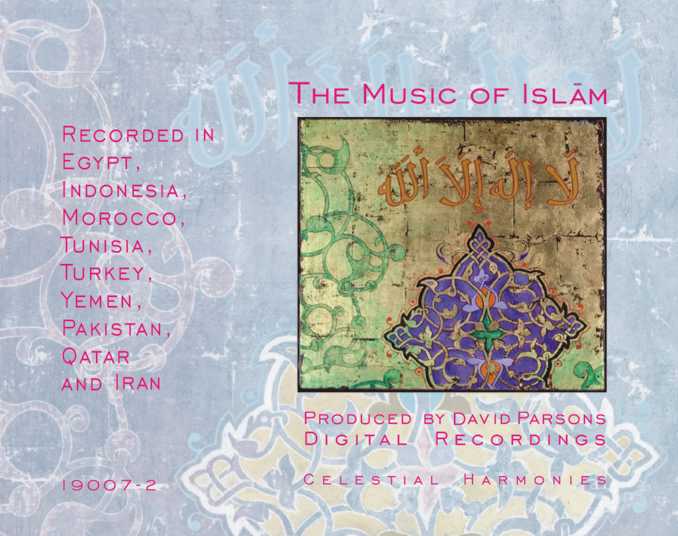
 19907 THE MUSIC OF ISLAM (17
CD BOXED SET) - VARIOUS
ARTISTS
19907 THE MUSIC OF ISLAM (17
CD BOXED SET) - VARIOUS
ARTISTS
Over 10 years and through nine countries
across the Islamic world, composer/engineer/producer David Parsons meticulously
recorded a diverse and rich musical landscape little known in the west.
The resulting 17-CD set on Tucson's Celestial Harmonies
label, The Music of Islam, won this year's Preis der Deutschen Schallplattenkritik
(the annual Award of the German Record Critics), Germany's top music
prize.
Songs and dances, ritual and concert music from Morocco
to Indonesia found their way to the set, as notable for its scholarly
notes as its rare musical insights into an area of the world frequently
vilified in the West for the acts of a handful of fundamentalist terrorists.
Parsons wasn't the only one kept busy. In Tucson, label
founder and president Eckart Rahn and his staff tracked down a dozen
specialists from Germany, Australia, the United Kingdom, New Zealand
and Indonesia to compile the 1,000-pages of liner notes for the set.
Burning the midnight oil with no days off for nearly two years, the
crew ran between fax machines and e-mail, compiling an unprecedented
view of Islamic culture that stretched well beyond the framework of
the music.
"This has in it the cultural history of the Islamic world,"
Rahn says. "We are a small record label, ill prepared to do the equivalent
of publishing a major novel and producing 1,000 pages with virtually
no typos."
The results are impressive. Each volume's notes sport
concise essays on Islamic folk art, music, technique, instruments, the
relationship of religion to music, the music's history, Islam itself,
calligraphy and attitudes of Islam and the West toward one another.
An additional set of notes details the particulars of each disc.
The recording project was equally monumental. Pared down
from 60 hours of tape to 20, the musical survey captured the efforts
of 200 musicians.
And there were obstacles along the way. The holiest of
sites of Mecca and Medina were off limits to the non-Islamic recording
crew, as was Saudi Arabia. And despite the approval of Iraq's U.N. ambassador,
the border was sealed both times crews were ready to record there. They
finally ended up recording classically-trained Iraqi musicians at a
Sheraton Inn in Qatar.
"You would assume that they were political refugees in
exile, but not so," Rahn says. "They were totally patriotic Iraqis unable
to make a living at home due to economic sanctions."
In addition to the boxed set, which sells for around $200,
15 volumes from the series have been released individually. There's
also a single-disc sampler with a track from each of the major Islamic
cultural centers. Most music stores carry Celestial Harmonies products.
A World of Music
When he was a young man, Eckart Rahn dreamed of being a museum director.
Instead, he founded the record label Celestial Harmonies and treats
his products like works of art.
On the first solo didgeridoo recording in history - recorded here in
Tucson by Steve Roach - Rahn used colored and textured papers for the
liner notes. "This is the red earth of Australia," he says, running
his finger along the CD cover. "You touch it. You see it. It's almost
like rock art in your hands."
For the award-winning Music of Islam set, Rahn housed the 17
CDs in a furniture-quality wooden box. Each CD cover features an example
of Arabic calligraphy, from historical examples to elegant contemporary
versions from across the Islamic belt. It's that kind of attention to
detail that has kept the Tucson-based Celestial Harmonies and its subsidiary
labels, Kuckuck and Black Sun, a hot record label for almost 20 years.
The German-born Rahn, 54, has just seen the greatest recognition of
his 30-plus years as a record producer. In October, his label's 17-CD
Music of Islam series won Germany's most prestigious music award,
the Preis der Deutschen Schallplattenkritik (the Award of the German
Record Critics).
Rahn's productions have been international - he has recorded music
from 40 countries, representing every continent. But he has a long way
to go. "There are over 200 countries that are members of the United
Nations," Rahn says, seated at his long, futuristic-looking desk at
the label's Fort Lowell Road headquarters. It's clear he'd like to see
their music on his label.
Rahn has been a pioneer throughout his years in the record business.
He began recording political rock in Germany, moving to the U.S. 26
years ago. He made business and record deals for such noted jazzmen
as Cecil Taylor, Gil Evans, Ornette Coleman, Dexter Gordon and Woody
Shaw.
In the early 1980s, he began to focus on the emerging phenomenon of
"new age" music with such artists as Kitaro and Terry Riley. Around
the same time, digital recording technology emerged. "In 1981, I did
my first digital piano recording," Rahn recalls. "The engineer fooled
me. I was listening to the tape but I thought I was hearing the pianist
live. There was no detectable difference in the control room between
the live feed and the playback of the tape."
The label was among a handful of the first in the U.S. to release its
music on CDs, and it constantly pushes the envelope to attain the greatest
clarity and richness from its recordings.
Wandering down the rows of tall metal shelving in the warehouse section
of the record company's building is almost a sentimental journey for
Rahn. "This is 1980 to '81," he says, pointing to a shelf stacked with
discs such as Tibetan Bells, Popul Vuh, some early David Hykes and the
Harmonic Choir recordings, and one by flutist James Newton.
A bit further down, his attention is caught by his 1992 box of Chinese
classical music. "This was the first time I got anything right," he
laughs. "It was the first time ever that there was a comprehensive introduction
to the concept of Chinese classical music. There's no written record
of Chinese traditional music. It's been verbally passed down for over
5,000 years." Farther down the aisle is a compilation of music from
Asia, a Cambodian boxed set, an anthology of Japanese music and another
of American classical music. They all catch his eye, as do his recordings
of Tucson's Mariachi Cobre and a seven-volume series on the music of
Armenia.
Originally, the Armenian series was to be a single CD, recorded by
engineer/composer/producer David Parsons. When it was recorded in Armenia,
Parsons was supposed to fly in from his New Zealand home, record for
a few days and leave. Instead, Parsons stayed for four months, calling
frequently to say "I found more music. Send more money."
Rahn moved his operation from the east coast to Tucson in 1988. It
just fit the way he prefers to live. "I'm a gray eminence in the wings,
watching the actors do their bit from the shadows," he says. "That's
why we moved to Tucson because in Tucson, you're in the shadows. "I
lived in New York for 15 years. I can tell you that every day I just
come here, park the car and walk in. Not even the richest man in the
universe can do that in Manhattan."
Rahn is no slacker, and neither is his staff of six. For the two years
that the Music of Islam series was in production, all worked
seven days a week, 365 days a year. They were on a mission. "If we don't
record this music, the next generation will not know what it was like,"
he says. "That younger generation wants to be more Western in all of
these countries, so they don't accept the music handed down by their
fathers. We must go and preserve this music."
He's also out to shatter stereotypes, where the radical actions of
a tiny fraction of its billion-plus believers taint the world's view.
"When a Christian shoots an abortion doctor, it's the same kind of terrorism,"
Rahn says. "But nobody would therefore call Christianity a terrorist
religion. The world music movement has one major advantage. It opens
up hearts and minds - especially young people's - to what is happening
outside of the countries in which they're living.
"The universal human values are all the same. We're all singing our
own kind of blues. The regional differences are quite superficial. A
love song is a love song, a sad song is a sad song and a holy song is
a holy song."
|