July/August 1999
Into Electronic Realms of India and Tibet: An Interview with David
Parsons
David Parsons is one of the most traveled artists in instrumental
music, owing to his exhaustive work for the Celestial Harmonies label,
recording authentic world music in many locales throughout Asia. He
is also a composer and musician himself, melding and fusing the ancient
with the modern to produce lush soundscapes of mystery and power that
both calm and mystify the listener. Through the kindness and generosity
of my friend and colleague in the Netherlands, Bert Strolenberg, we
are able to present this interview with David. I know you will enjoy
it.
David, on your CDs, there is little background info on you and your
music. Can you, as a start, provide us with a good description of who
you are and say something in general about your music?.
I'm 54 years old, married to Kay and have a six-year old daughter called
Annapurna (Anna for short). I also have two other daughters, Wendy &
Sarah, from a previous marriage who are now grown up and living in Sydney,
Australia. My interest in music began when I taught myself drums at
around the age of fourteen or fifteen and ended up playing in jazz groups
professionally for a while. I found being a drummer increasingly frustrating
and, after a time, yearned to play a melodic instrument. I tried guitar
and even trombone but I never felt any passion for those instruments
and lacked the drive to persevere. In the early '60s - and before being
"discovered" by the Beatles - Ravi Shankar came to Wellington, New Zealand
and gave a concert to a small audience. I went along because I was curious
about the tabla drums, having recently read an article in Downbeat magazine
about Indian percussionists. As soon as Ravi Shankar walked out on to
the stage carrying his sitar I immediately feel head over heels in love
with the instrument even before I heard him play. Just the look of it
filled me with a passion to learn to play it and, when I heard him play,
tears came to my eyes. Thus began a lifelong love of the sitar and Indian
music in general. This eventually broadened out into a fascination and
love for all non-Western music traditions. It took me three years to
get a sitar and then I taught myself for seven years. I eventually went
to Varanasi, India to study formally.
You have produced four solo CDs. What have you done before these
albums? Prior to my four solo albums, the only other recordings I ever
did were as a session sitar and surbahar player on a couple of Indian
music projects.
On your albums, a nice combination of ethnic-oriented electronic
and spacemusic is heard, which is thrown into a huge Tibetan & India
soundscapeworld. Can you say something about the background of this?
What's so special about working with these influences? I guess your
extensive travels in those regions have contributed to them and inspired
a lot.
The reason my music developed the way it did was my obvious affinity
with Indian music. In fact, my only formal music training has been in
India. I don't think in Western terms, musicallly speaking. I see all
music in terms of Indian music theory and, therefore, I don't have much
knowledge regarding harmony, etc. I became interested in the physics
of sound creation and my ears had really been opened to this by my years
of studying Indian music. Around 1979, I bought a Roland SH-7 synthesizer
and a Revox tape recorder and started experimenting. The Revox had the
facility of "sound on sound" which allowed me to layer an unlimited
number of tracks (albeit with rapidly increasing noise). I naturally
included many of my Indian instruments, in particular my tanpuras, to
the synthsizer tracks and I found the combination of timbres very pleasing
to the ear. I also added other natural sounds such as birds, water and
sounds from my trips to India. This was before the days of samplers,
so these natural sounds were layered in from a second tape recorder.
One day, I was playing some of my finished tapes to some people who
had heard about what I was doing and they suggested I release these
as an album. I really thought they were joking, but they insisted and
my first album Sounds of the Mothership (17013-2)
was born. I couldn't believe that anyone could possibly like what I
had done, but the album sold well in New Zealand amongst the "new age"
fraternity. Eventually it was picked up and released worldwide, along
with my second album, Tibetan Plateau (17013-2),
on the Fortuna label (which is now part of the Celestial Harmonies group).
I don't know what it was that people liked about Mothership. By today's
standards it was very crudely put together. It wasn't even my idea to
call it Sounds of the Mothership, I thought, at the time, that the name
sounded rather pretentious but [I] went along with the flow thinking
that it would never sell anyway. In those days, I didn't know what "new
age music" was either. I just did what I did and that's how the music
came out. Today, I'm still receiving royalties from that album and it's
still getting airplay and I don't know why.
To summarize, my music is simply what naturally flows from me, good
or bad. It is just my life experience. I do not compose music for a
market because if I composed music just to make money I think my music
would lack integrity. I have to compose what I like and if the market
doesn't like what I do then I guess that's too bad (for me, at any rate).
I can, however, put on another hat, so to speak, and compose music for
films and TV commercials. This is an entirely separate musical idiom
and one which I also enjoy because of its own unique disciplines and
the magic of combining sound with visuals. It is a wonderful training
ground for synthesizer programming and sound engineering, especially
when working to tight deadlines. This is a nice change from composing
albums. Of course, my "commercial" music is still limited to my Indian
training, so I tend to write in a moody atmospheric style, blurring
the differences between music, natural sound and effects.
All your albums feature musical solo-activities in which you often
use prerecorded tapes and sophisticated sample-techniques. Have you
ever felt like working together with somebody else live in the studio
or in any other sense? Are there any electronic or other musicians that
come to your mind you would love to work with sometime?
I've always worked alone when working on album music. I've always approached
my music as a painter would his or her art. The idea of two painters
working on the same canvas is a little strange to me. Of course I'm
open to ideas on this, but I think I would probably tend to let the
other person take over.
Your latest music [at the time this interview was conducted, that
is - Ed.] can be found as three unreleased tracks, featured on a sampler-CD
on Celestial Harmonies called Musique Mechanique (14102-2).
What have you done since that? I heard you had a very large project
on your hands concerning the production of a large series of world music,
which took many years.
Since 1993 all of us (me, Kay & Anna) have been travelling extensively
for Celestial Harmonies, recording and producing the music of many cultures.
We have completed projects - many are multi-disc sets - in India, Cambodia
(19902-2), Vietnam (19903-2),
Indonesia (19905-2), Egypt (13140-2,
13141-2 ,
13142-2), Morocco (14144-2,
13146-2, 13147-2),
Tunisia (13148-2), Armenia (19909-2),
Turkey (13149-2, 13150-2,
13154-2), Iran (13152-2),
Pakistan (13153-2), Yemen (13151-2)
and Qatar (13143-2). It has been
the most wonderful experience of our lives and we have made many, many
lifelong friends in these countries.
This has now come to an end and so I'm busy composing my own music
once again. It has been quite difficult, after working with many great
musicians in other cultures, to get into a composing frame of mind again.
I felt bored by synthesizers until I decided to take the plunge, financially
speaking, and bought myself a fully-optioned Kurzweil. I'd been dreaming
about one for years but they were, and are, prohibitively expensive.
Anyway, that was a year ago and I haven't regretted it. For me the Kurzweil
is the most inspirational piece of equipment I've ever worked with.
I have spent the last year studying it in depth, and believe me its
very deep, and programming and sampling my own sounds for it. Incidentally,
I almost invariably only use sounds that I have created in my music
and this goes for all my synthesizers. I consider sound creation as
a major part of my compositions, so using other people's or factory
sounds is like having other people writing my music.
I have completed three new album projects. The last one is almost entirely
done on the Kurzweil. The first entitles, Ngaio Gamelan (13171-2),
is being released by Celestial Harmonies as I write this [ED. Note:
this CD is reviewed in this issue]. Ngaio Gamelan started off as a demo.
While working on "world music," I began to realise that music from different
non-Western cultures had certain things in common and that it would
be quite feasible to take some musicians from, say, Armenia and India
and get them to work with Indonesian musicians. So I wrote this project
as an experiment and demo to interest others in this idea of an East/East
fusion, rather than an East/West fusion. However, Celestial Harmonies
liked my demo as a project in itself and have released it as such. I
am a little apprehensive about this release because I'm worried that
people that like my previous albums may feel a little disappointed if
they are expecting a natural progression from my last CD Dorje Ling
(17076-2). Especially as this is
my first new release after so long. All I ask of them is to "hang in
there" because my other two are more of what would be expected. These
albums are completed but haven't been officially given to any record
company yet. The first is called Parikrama (14202-2).
It means a pilgrimage to, and a circumnambulation around, an especially
powerful or holy site such as Mount Kailash in Tibet. This album is
the natural follow-up to Dorje Ling. It is quite dark and meditative.
The second does not have a title yet. It is quite different from Parikrama
as it is rhythmic and more Middle Eastern/Central Asian in its influences.
I like it probably the best of the three and it will be interesting
to see what the reaction is in the marketplace (that is, if any record
company wants it). I am currently working (I've completed sixteen-minutes)
on a new project which is turning out to be purely "space music" or
at least the closest I get to that genre.
You know Jon Mark [Ed. Note: Jon Mark is an ambient keyboardist
who also lives in New Zealand]. How did you two meet? Did you ever consider
doing something together in any way? Are there other fellow-musicians
with whom you stay in touch regularly?
When Jon Mark and his family moved to New Zealand from the USA they
settled in Wellington, which is my home town, so we naturally got together.
He has helped me a great deal with my music career with very well-founded
advice based on his very real knowledge of the music business world
wide. We have, from time to time, considered doing something together
but have never gotten around to it. [This is] more my fault than his,
as I tend to be a bit of a hermit and I thin people give up on me after
a while. There's no one I stay in touch with really, except lately with
Glenn Deardorff, who has also been a great help to me. I really like
his new album, Primordial Mariner, and am glad to see it's getting the
airplay it deserves. Now that I'm online, I'm hoping to make more friends
globally. I don't have a website because I can't really afford to have
one designed and I lack the skills to do it myself but my email address
[dapka@ihug.co.nz] is freely available
to anyone interested.
Did you ever perform your music live on-stage, or do you consider
your music only suitable for the studio?
I have never, nor could I, perform live on-stage. As I mentioned above,
I approach my music as a sound painting, so it's restricted to the studio
only. I'm not a keyboard player. I treat the keyboard as a series of
switches to trigger events so I'd be a pretty boring stage act. The
only time I perform live is with the sitar and that is quite a rare
event these days.
Do you have any thoughts about the current state of electronic music?
Do you have any personal goals in music? And what kind of music do you
personally enjoy listening to?
I think electronic music today is way ahead of the time when I first
started dabbling in it. The technology has improved immensely and so
have the programming and compositional skills. I think the only downside
has been the popularity of "rom boxes" in the last decade. I know that
the Kurzweil can also be used as a rom box but if you're inventive you
can use those basic acoustic samples to create new and interesting sounds,
especially with the tools a Kurzweil has to offer. I love all the new
techno music - particularly trancd-dance, of course. There's some real
depth to this music, in my opinion, and the programming and sample manipulation
can be superb. My favourite music to listen is still Indian Classical
Music, from both the northen and southern traditions. I enjoy cooking,
especially Indian vegetarian cuisine. There's nothing so relaxing and
pleasurable for me than to be cooking a great curry, having a glass
of red wine and playing my Indian CDs. I also like to listen to Armenian
music, Sting, Brian Eno, Phil Collins and techno.
Like all musicians, I presume you also have future plans for your
music. What can people expect from you in the near or far-off future?
Have you any idea in what direction your music will evolve?
I always have this fantasy that one day I will create a sound that
will lift people out of the humdrum and stress of their everyday lives.
It's probably the music of the spheres or the sound of OM that I'm grasping
for. I know I'll never achieve it but I guess it's the trying that counts
and who know what I might discover along the way. I do all my personal
music intuitively, so it evolves of its own volition. I never start
with a plan - everything starts with messing around with sounds until
suddenly one thing inspires, and this leads on to other ideas, etc,
etc. So I never know how a piece will turn out until its complete. I
have no idea where my music will go in the future.
1998
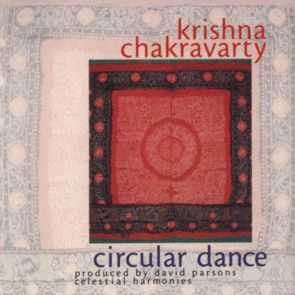
 13133 CIRCULAR DANCE
- KRISHNA CHAKRAVARTY
13133 CIRCULAR DANCE
- KRISHNA CHAKRAVARTY
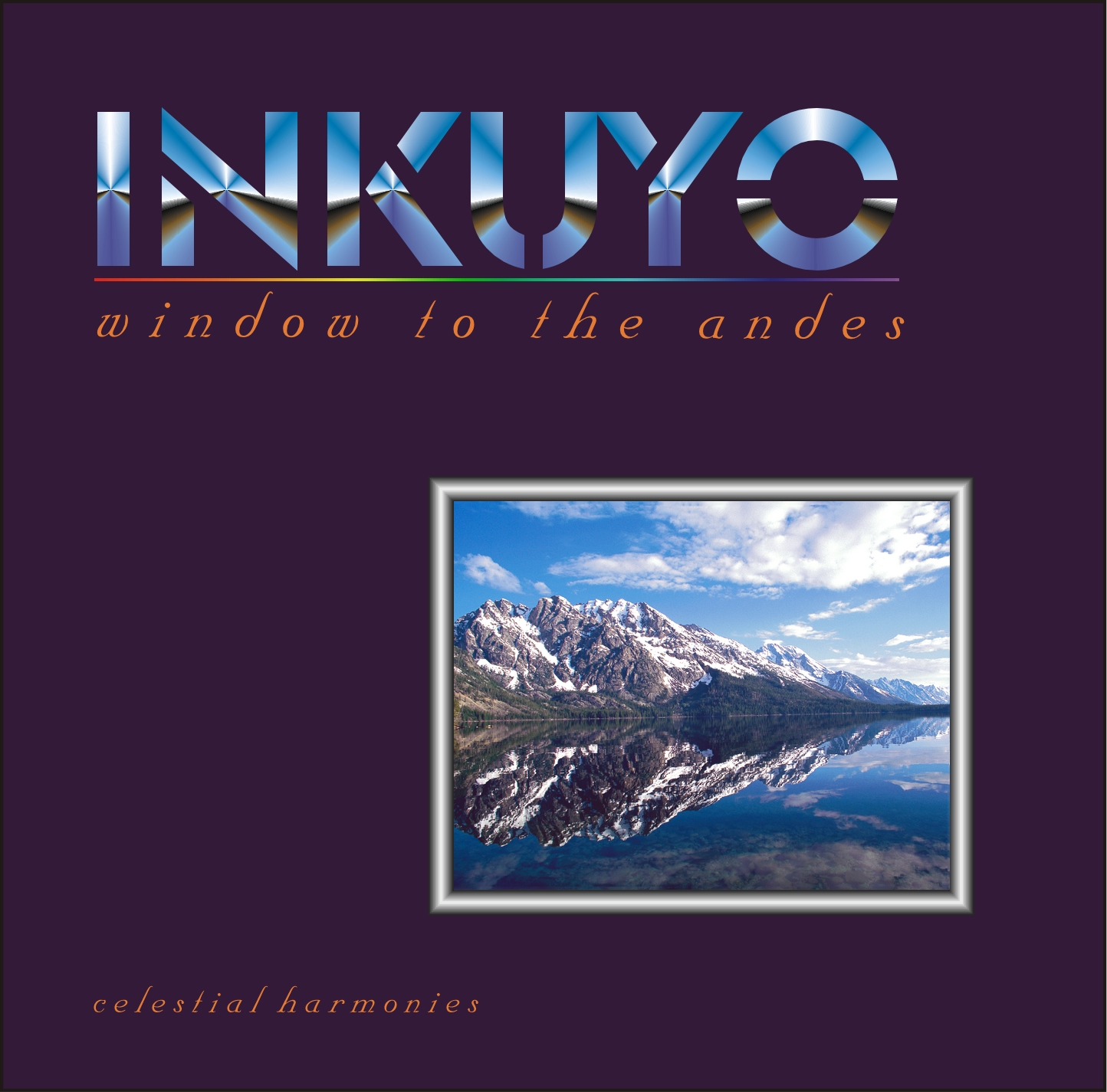
13173 WINDOW TO THE ANDES
- INKUYO
The Celestial Harmonies label once again shows it is a powerful force
in the area of authentic world music with these two releases. Both have
a lot to recommend them and are damn near essential for listeners with
world beat taste or an ear for excellent recordings of cultural music.
The South American trio, Inkuyo, delivers another superb CD of traditional
Andean music, featuring their great blend of string and wind instruments
(think guitars and pan pipes, although the authentic names for the instruments
include charango, quena, quenacho, and bandurria). On Window to the
Andes the listener is treated to a blend of uptempo numbers, overflowing
with joy, as well as more sedate wistful songs. There is a small amount
of vocals on the recording, but the vast majority of the music is instrumental
- and it's all great stuff. For fans of the German world fusion band
Cusco's two Apurimac releases, why not listen to the real thing this
time? I think you'll be pleasantly surprised! Inkuyo are still the band
to beat when it comes to Andean music. Great stuff and one hundred percent
life-affirming.
From a whole other part of the world, India, comes a very strong recording
of traditional sitar music featuring the awesome talent of Dr. Krishna
Chakravarty, one of the premier sitarists in her native country of India.
Circular Dance is produced and recorded by none other than David Parsons,
however, don't expect any of Parson's fusion textures. The pieces here
are unadorned ragas, fully developed through their stages, from the
alap ( slow and languid) through the jhalla (climactic fast tempo).
Dr. Chakravarty is accompanied on tabla by Vinod Gangadhar Lele, and
he is a very accomplished musician, as well. But it is Dr. Chakravarty
who amazes me here. She is a marvel at producing some truly exquisite
music as her playing goes through tempos and melodies with incredible
ease. These three pieces are wonderfully liquid and are among the best
Indian recordings I've heard. The two ragas (the first two "songs")
are each over twenty-five minutes long so this music really takes its
time developing as it winds its way to a firey conclusion. If all you
have heard of East Indian music is the fusion work of Al Gromer Khan,
you should listen to this. It is the work of a great musician and an
immersion in authenticity of the highest degree.
I want to add that, as is usually the case with Celestial Harmonies,
the liner notes are excellent for both of these recordings. In each
instance, extensive knowledge about the music itself is given, so the
notes are both entertaining and educational. Celestial Harmonies is
not just a leader in music, but in superb packaging. Their CDs are always
a complete package.
* * * *
|