
April 29, 2002
Such divine intervention needed to sell overseas
At least one man is helping Australian musicians gain recognition abroad.
Few things are harder to bring off for performers and composers of
concert music or opera who live in this country than to have the recordings
they make here fully distributed and available in Europe, North America
or Asia.
It's a serious limitation, because recordings act as effective visiting
cards for touring groups and individuals and can add greatly, through
direct sale or radio broadcasts, to the admiring and expectant audiences
these musicians hope to cultivate overseas.
A huge resource is available in the catalogues of ABC Classics, Melbourne's
Move Records (our oldest surviving record company) and Tall Poppies,
to mention three especially enterprising labels, and in the lists of
smaller or newer concerns such as Andrew McKeich's Artworks or the Australian
Music Centre's VAST series. Then there are the local issues, usually
restricted to local distribution, produced by major international companies
such as Universal and Sony.
The thing they have in common is that an invisible but powerful barrier
stands in the way of encountering nearly all this output anywhere but
in Australia. Look at retail record shelves or boxes in London or New
York, Paris or Berlin, and it's almost certain that you won't find any
of the discs belonging to this category.
If you lived in Europe or North America and were utterly determined
to find them you might have some success. The foreign agents for these
Australian issues are sometimes listed in fine print at the back of
specialised record magazines. Add a bit of determination and a dash
of patience to some original curiosity or interest and it's possible
that the disc will come your way. Or, if you wrote to an Australian
record shop of the right kind, you could take advantage of the exchange
rate to import these discs for a modest local price.
Mind you, as a foreigner you would have to be a keen Internet scanner
or have some special source of information to know that they are there
at all. Without effective distribution there is no point in newspapers
or journals reviewing them.
Most of our leading labels, such as ABC Classics, have done deals for
particular issues and had a degree of short–lived success in penetrating
the difficult and over–supplied markets of the northern hemisphere.
I remember when Belinda Webster, founder of the Tall Poppies label,
was awarded some travelling funds, took her discs to London, and found
personal contact and direct sampling a potent means of interesting retailers
and reviewers in her wares. For a time you could find her discs at the
big Tower Records' shops. The reviews were numerous and appreciative,
and and the Australia Ensemble's Tall Poppies disc of Mozart flute and
oboe quartets became the preferred issue listed in London's Good Record
Guide. Webster's lack of resources or time to follow up her tiny commercial
toehold meant that interest faded.
What is the solution? An Australian agent, superlatively familiar with
repertory and persuasive in musical as well as commercial terms, operating
in Europe, with another one in North America and another to cultivate
the important Japanese market? An overseas distributor paid to be diligent
in promoting Australian–produced recordings? Perhaps, but experience
suggests that it may be better to find someone from one of those markets,
an independent spirit who wants really wants, out of personal taste
and enthusiasm to make recordings here and sell them here and abroad.
Which brings me to the unusual history of Eckart
Rahn, the president of an international label, Celestial Harmonies,
who has a genuine and persistent liking, expressed in more than 40 discs,
for recording those Australian or Australian–resident composers
and performers (or, more often, composer–performers) who appeal
to him.
Among them are the composer–percussionist Michael
Askill and the renowned percussion group, Synergy, that he helped
bring into being; Roland Peelman's brilliant Song Company in a recording
of Heinrich Schütz's Swansong
collection from the later 17th century; Riley Lee and the versatile
performer–composer James
Ashley Franklin playing shakuhachi, the Japanese end–blown
flute, in traditional and original music; the multi–instrumentalist–cum-composer
Michael Atherton; Winsome
Evans's Renaissance Players
in a set of copiously documented discs devoted to the lively music of
Sephardic Jewish communities; the didgeridoo players and composers
Alan Dargin, Matthew Doyle and David
Hudson. Rahn admires the local sound technicians who capture their
music within his label's trademark technique of simple, direct and truthful
microphone placement.
No wonder the Premier, Bob Carr, was happy to provide a welcoming note
to go with a Celestial Harmonies disc
of excerpts from its Australian recordings released to coincide
with the 2000 Sydney Olympic Games. Most of the performers, composers
(including Ross Edwards and Ian Cleworth) and recording engineers represented
belong to or work in New South Wales.
Their recordings go overseas and are central to Rahn's catalogue, along
with the improvisations of a Munich organ virtuoso, Franz
Lehrndorfer, the piano music of the Lithuanian composer Mikalojus
Ciurlionis, works by Schubert and other standard composers, and issue
after issue of what used to be called ethnomusicological field recordings
and later "world music" the traditional idioms of Cambodia,
Vietnam and Armenia,
for example, in multi–disc boxes. A 17–disc issue entitled
Music of Islam helps disclose how
richly various the cultures are that embrace that religion.
German and New York radio stations regularly play the Celestial
Harmonies recordings of Australian musicians. A New York radio producer
has prepared a disc of selections from Evans's recordings of Sephardic
music. Further, these discs remain in the catalogue and are not
subject to the deletions practised by many large recording companies.
Rahn is understandably proud that all his recordings have stayed in
print.
Born in Germany in 1944 and gifted with an insatiable curiosity about
the world's musics rather than by his own reckoning any pronounced musical
aptitude, he is a European with a liking for places where the sunlight
seems to burn away some of the assumptions and hang–ups of the
continent where he was born. His headquarters are now in Tucson, Arizona,
and he has an apartment on the Gold Coast he regularly uses as the base
of his Australian operations. This week sees him at the end of one of
his Gold Coast stays and forming plans for new Australian recordings.
It's probably no use showering him with discs and tapes, however, in
the hope of exciting him about your special project. He has been happy
to produce special discs to go with exhibitions of Indian
and Buddhist art at the Art Gallery
of New South Wales because these were extensions of his interests. His
independence is complete. He listens to the radio, hears what he wants
to, develops his own tastes, makes his own choices.
He is not the man to answer a need for a concerted plan to represent
overseas Australian players and composers on disc, but he is one of
the best and truest friends our performing and creative musicians have.
March 29, 2002
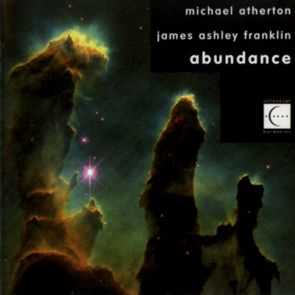
 13192 ABUNDANCE - MICHAEL
ATHERTON AND JAMES ASHLEY FRANKLIN (.pdf)
13192 ABUNDANCE - MICHAEL
ATHERTON AND JAMES ASHLEY FRANKLIN (.pdf)
Blurring Japanese
Intercultural music is the term favoured by Michael
Atherton and James Ashley
Franklin for the kind of creative interaction they engage in on
this record. The blending or blurring of traditions is deliberately
limited. Franklin plays the shakuhachi (the Japanese bamboo flute)
for each of its eight tracks and twice dubs in his playing of the koto
(the Japanese long zither). Atherton adds instrumental sounds from several
different traditions, including Egyptian harp, vibraphone, guitar and
didgeridoo.
Their contributions do, however, mostly complement the typically free–flowing
and hauntingly meditative character of the shakuhachi. Just occasionally
the collaboration goes further than techniques of transformed echo,
simple punctuation or interrupted refrain. The guitar, for example,
in Rejoicing World, adds harmonic and metrical dimensions absent
from most of the other tracks.
The didgeridoo in Desert Horizon adds drone sounds and
rhythmic pulsations to a texture that also contains the sounds of the
shakuhachi, koto and the Korean drum, called changgo.
Atherton occasionally makes the didgeridoo pulsations surge dynamically
in a way that takes traditional 'flares' a step further.
On all but one track, both players engage in structured improvisation
in which they respond to small nudges to each other to extend or vary
traditional styles belonging to a given instrument. The exceptional
track is a composition by Franklin, Salz/Salt of the Earth, commissioned,
rather surprisingly, for the 1999 German Lutheran Church Convention.
Perhaps out of consideration for Lutheran sensibilities, Franklin adjusted
a traditional shakuhachi genre to take it closer to European
modal character.
Mountain Grandeur lives up to its name by piling up six ridges
or layers of shakuhachi with throbs and rattles from metal percussion.
Franklin, a Western-trained composer, began his shakuhachi studies
with Riley Lee and attained his rank as a master player in Japan. He
makes an eloquent case for the instrument's ability to take on new challenges
without losing sight of its stylistic origins. Atherton demonstrates
again his instinctive quickness and sensitivity in making music with
a diverse group of instruments.
Saturday December 15, 2001
114215 BUDDHA: RADIANT AWAKENING
- VARIOUS ARTISTS (AVAILABLE EXCLUSIVELY IN AUSTRALIA FROM THE BOOK
SHOP AT THE ART GALLERY OF NEW SOUTH WALES IN AUSTRALIA)
Calm as you are
BUDDHA: RADIANT AWAKENING
Field recordings and new works (Celestial Harmonies)
Roger Covell gets a lesson in world championship chanting.
Produced in association with the current exhibition at the Art Gallery
of NSW, this wide–ranging recording of musical sounds taken from
or inspired by Buddhist ceremonies brings into play an unusual conjunction
of enterprise and talent.
The first disc of this release is devoted to traditional Buddhist chants
and rituals, recorded at ceremonies by David
Parsons, a New Zealand composer and general musical explorer.
The first track may well strike listeners as austere, consisting as
it does of chanting to a single pitch by a solitary Japanese nun in
a Japanese shrine near the holiest of Buddhist sites in India, the Mahabodhi
Temple at Bodhgaya. The only sounds punctuating her rhythmic monotone
are gong strokes and the occasional shrieks of children playing nearby.
This provides a means of tuning in to Buddhist calm persistence.
Another track records the evening prayer chanted by Indian monks at
the Mahabodhi Temple itself.
Their parallel singing sounds like a surprisingly close equivalent
of the organum practised in Western European Christian churches in the
medieval period.
Daily chanting at the Tibetan temple in the same area prompts some
instrumental liveliness from Tibetan oboes, horns and trumpets and conch–shell
trumpets.
An extended track (nearly 19 minutes) of chanted prayers at a Thai
temple takes advantage of its resonant acoustics; this source also yields
a melodically varied solo chant from a singer identified as Dr Phramahachalong
Candisiri, who seems unperturbed by brief descants of traffic noises.
The second disc begins with Dawn, James
Ashley Franklin's reflection of a species of classic Zen pieces,
played by Franklin on the Japanese bamboo flute, the shakuhachi,
in the Japanese Garden at Cowra.
Lee's eloquent shakuhachi is part of the composer–percussionist
Michael Askill's Invisible Forces, the final section of his
evocative, Buddhist–influenced music for Graeme Murphy's 1999 dance
piece, Air and Other Invisible Forces.
Music originally intended for funerals from the Northern Thai String
Ensemble and Chiang Yuen Ensemble is particularly attractive in its
airy texture. Buddhist music from Laos includes the piquant sound of
a Laotian oboe with xylophones, drums, gongs and a plastic end-blown
flute and, from Myanmar (Burma), auspicious instrumental music for conch–shell
trumpet, brass plaque and gong as a prelude to a parallel chant.
Conch–shell sounds also introduce a series of Japanese Buddhist
chants, many of them with characteristic chesty glides in their trajectories.
The final track, David Parsons's Maitreya (the future Buddha) brings
together samples of music from four monasteries and temples in India
and from the Theravada monastery in Stokes Valley, New Zealand.
Its combination of deep–voiced intonations, monotonal and parallel
chants and layered instrumental sounds is an engaging and uncomplicated
musical image of Buddhism in the 21st century.
Anyone wanting to pursue unhurried thoughts, free of short-breathed
priorities, might use Parsons's synthesis as a point of entry into the
sounds of this beautifully presented recorded compilation as a whole.
Saturday May 6, 2000

15030
RHYTHM IN THE ABSTRACT:
SELECTED PIECES 1987-1999- MICHAEL ASKILL
Michael Askill is the composer and percussionist whose collaborations
with Graeme Murphy in the integration of music into dance and dance
into music probably reached their peak in Salome.
Askill presents here a selection of the music with which he has been
associated over a period of more than a dozen years. Many of the pieces
are by Askill himself, though he is the first to acknowledge the creative
contributions of such musicians as Riley Lee (shakuhachi), Omar Faruk
Tekbilek, Michael Atherton, David Hudson and others. There are excerpts
from Salome and other scores.
The disc also includes piece wholly by other composers—two of
Ross Edward's engaging marimba dances and Nigel Westlake's brilliant
Omphalo Centric Lecture—but performed by Askill.
The cover notes make it clear just how important Askill has been as
a means of introducing the work of many Australian-based musicians to
the Black Sun label in the United States and to collectors of its recordings.
His music wears easily the notion of a Pacific rim idiom in which different
influences are blended without stiffness or self–consciousness.
Many people have used this idea as a manifesto or slogan; Askill makes
it work.
Listeners who accept a new sound as a part of life's aural development
will enjoy this disc from a perpetually tactile explorer.
Saturday May 6, 2000
From folk song to raga, from Morocco to Aceh, this is a remarkable
15-volume tapestry of music created from the diverse cultures of Islamic
culture
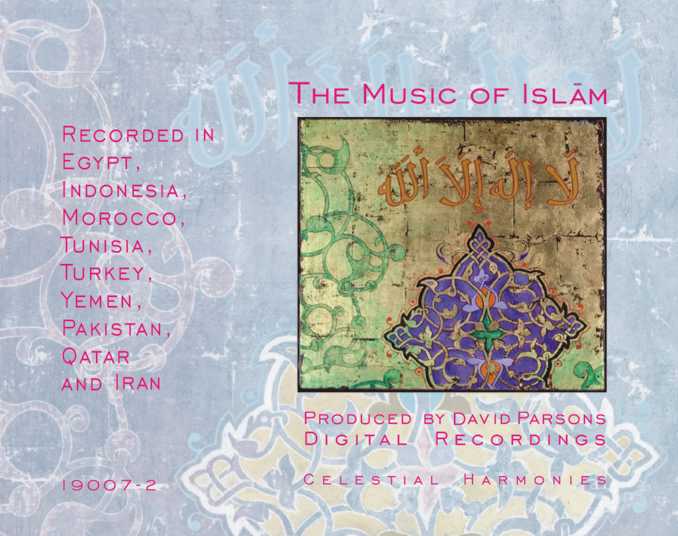
19907 THE MUSIC OF ISLAM
(17 CD BOXED SET) - VARIOUS ARTISTS
Is seems we must find a pigeon–hole for everything.
Even if differences are mica–thin, and only appreciated by obsessive
aficionados, there is still a need to find a new term for a new genre.
Never mind the idea that the greatest art often defies categorisation.
So into what genre does a beautifully packaged (it comes in a handsome
wooden box and each volume has a 60–page booklet), 17–CD opus
titled The Music of Islam fit? Is it folk music? For surely volume
3, Music of the Nubians, by the Aswan Troupe for Folkloric Arts, fits
that description? Is is classical/art music as performed on volume 12,
Music of Iran? Is it ethnic, as typified by two CDs of music from Indonesia?
This genre problem was creatively solved by the German equivalent
of the Grammy's when, deciding that this outstanding collection had
to be acknowledged but not knowing how to categorise it, they created
a section called "other." The Music of Islam was awarded the
Pris Der Deutschen Schallplattenkritik, a special award in honour of
a major recording achievement.
The whole enterprise is unwieldy, but the result is a superb overview
of music inspired by one of the world's great religions. Here are the
musical styles of the Islamic communities in Egypt (both classical and
folk from the Sinai Bedouins and the Nubians), Qatar, Morocco, Tunisia,
Turkey, Yemen, Iran, Pakistan and Indonesia.
There are moments when the music reaches beyond these countries: volume
six features the music of the Moroccan descendants of West African slaves
from Mali and Senegal; volume seven is Andalusian music in Morocco;
and volume 10 is nearly 66 minutes of non–stop Koran recitation
by Turkish experts, including the professor of Koran recitation from
Marmara University in Turkey.
It is hard to work out what "comprehensive" means in terms
of the totality of Islam. Certainly this collection is wide–ranging,
both geographically and stylistically, and the range of instruments
and musical approaches is diverse.
However, even the most willing pair of Western ears will find problematic
some of the music in the collection.
The extensive notes and their detailed explanations are illuminating.
It is possible to buy the individual CDs and a sampler is also available.
If, however, you want to appreciate one of the world's most complex
musical cultures then this boxed set is rewarding.
August 6 - 15, 1999 (The Guide)
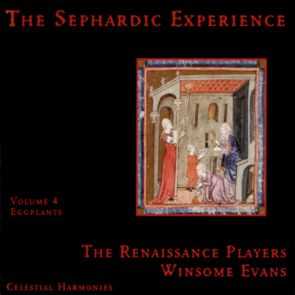
13169 THE
SEPHARDIC EXPERIENCE, VOLUME 4: EGGPLANTS - THE RENAISSANCE
PLAYERS, WINSOME EVANS - DIRECTOR
Winsome Evans's fascinating exploration of the musical world of dispersed
Sephardic Jewry takes her into realms of music (and life in general)
which are both related to her exploration of surviving medieval repertoire
and go well beyond it into regions of timeless practice.
Volume 4, issued under the Celestial Harmonies label, is subtitled
Eggplants for the very good reason that its opening piece is
a transcription and reworking of a traditional song from Rhodes which
deals, among other things, with the cooking of the eggplant, a much–prized
element of Mediterranean and Middle Eastern cooking. It stands in this
anthology for one of the richly flavoured elements of culture and memory
that helped to link Sephardic Jews, who had been driven out of the Spanish
peninsula after 1492 by the edicts of Ferdinand and Isabella and their
successors.
Naturally, Evans's vast experience in organising, rhythmicising and
ornamenting medieval melody is vital in her warmly sympathetic approach
to the songs and dances she has found in printed notation or in the
memories of friends and colleagues. She is able to extend her effective
use of plangent woodwind timbres and her imaginative deployment of melodic
variation and rhythmic patterning, drawing where possible on known formulas
of improvisation and extension.
Her printed notes on the background of the piece and the societies
that produced them are fascinating. The whole project, by which Professor
Evans and her ensemble are paying tribute to traditions in imminent
danger of disappearing, is one of the most encouraging instances of
creative and re–creative passion in Australian musical enterprise.
Monday December 14, 1998 (Arts)
Record Rahn Loves the Sound of Silence
Play a note on a flute in the Taj Mahal and it will reverberate for
18 seconds, Eckart Rahn explains. The president of the Celestial Harmonies
recording label is full of such arcane detail. This self–confessed
child of the '60 s can expound at length on subjects as disparate as
the finer points of Islam, what made Jimi Hendrix unique, how composers
and conductors are the Johnny-come-latelys of classical music, or philosophise
about the value of silence.
His point about the Taj is that a recording studio is no place for
a great musician. "The recording studio is the worst of places
to record music because it is only there for the convenience of engineers,"
he said. "No great composer has written a piece for the recording
studio."
It was this belief that informed the CD The Sound Inside: Music
and Architecture, exploring the connection between fine music and
fine buildings. The result is recordings in such icons as the Taj Mahal,
Istanbul's Great Suleymaniye Mosque and Egypt's Great Pyramid. In Sydney,
he has recorded The Song Company performing in the Opera House and Saint
Scolastica's Convent Chapel.
"Throughout the world, all the great pieces were written for particular
spaces—mostly for churches, temples, courts, opera houses, concert
halls—places that were built with good sound in mind," he
said. Hearing sound in such a space adds a sense of awe and mystery
to the experience. "The music has a quality that something produced
in an artificial space only rarely has."
Australia has been a regular stop for German–born Rahn as he has
traveled the globe for 30 years in search of the eclectic sounds that
form his 400–plus catalogue. He was in Sydney earlier this month
for the release of composer and percussionist Michael Askill's CD Salome.
Askill composed the music for the Sydney Dance Company's version of
the Biblical tale earlier this year. The album saw Askill team up with
Turkish musician and singer Omar Faruk Tekbilek to create a sound that
draws on Middle Eastern musical traditions. It is the latest in a number
of projects Askill and Rahn have worked on since Rahn, having heard
of Askill's work with the percussion ensemble Synergy, looked up his
name in the phone book and called him about five years ago. "We
got together about 20 minutes later," Rahn said.
The bloody tale of Salome, who asked for the head of John the Baptist
in return for dancing for King Herod, came at a time when written music
was unknown. "He [Askill] brings back the spirit of that music,"
said Rahn.
Salome is Rahn's springboard into his argument that composers and conductors
are the johnny–come–latelys of music. "The written music,
where the composer is the main man, has only existed for 300 or 400
years and for maybe five per cent of the world's population, from Portugal
to Russia," he said.
"[In Asia] pieces are handed down. But there's a strict repertoire
of rules depending on whether it's written for the temple, a particular
time of day...it's not free jazz, neither is it composed because the
musician has a lot of freedom."
The peripatetic Rahn, who is based in Arizona, returned to his former
home city Bonn in October to accept the prestigious German Music Critics
award for his mammoth 17–CD set, The Music of Islam.
After producing a number of CDs of Asian music—from Cambodian
gamelan to Tibetan Buddhist chants, Rahn decided Islam was one of the
last musical frontiers. So little is known or understood in the West
about the diversity of Islam and its music.
"Most people think of Islamic music as being Arabic music and
that is vastly misleading...it reduces its variety and cultural wealth."
The epic project, which he cheerfully admits went way over budget, meant
recording musicians everywhere from Morocco to Indonesia.
His approach to recording music is, he argues, in keeping with the
spirit of the '60s, with which he still identifies. He's not interested
in doing 50 takes in a recording studio to get a track down.
"In the '60s, it was not important how good it sounded, it was
important how much it meant. Some of the greatest recordings from the
'60 s, from Jimi Hendrix to the Grateful Dead, are not terribly good
sounding records, but they have a spur–of–the–moment
intensity...in a strange sense we are reverting to that. In projects
like this [The Music of Islam] you are dealing with master musicians
who get it right in a take or two," he said.
Despite—or perhaps because of—his long involvement with recorded
music, Rahn's favorite sound is silence. With music almost ever–present—from
elevators to railway stations—we have devalued its currency and
taken away its context.
"In Bach's day, people would only hear music on Sundays in church,
so when the music came it was special. We have reversed that, so by
having the radio on in the taxi and having music in the hotel lounge
it is difficult to get away from music."
Recording and broadcasting might have enabled people to listen to all
the music of the world, but they have taken the relevance out of listening
to music, he said. "The only way to cleanse you system is silence,
so that when you listen again you have the power of concentration and
you are not overloading yourself because you are doing too much of it."
Listen wisely.
April 21, 1997
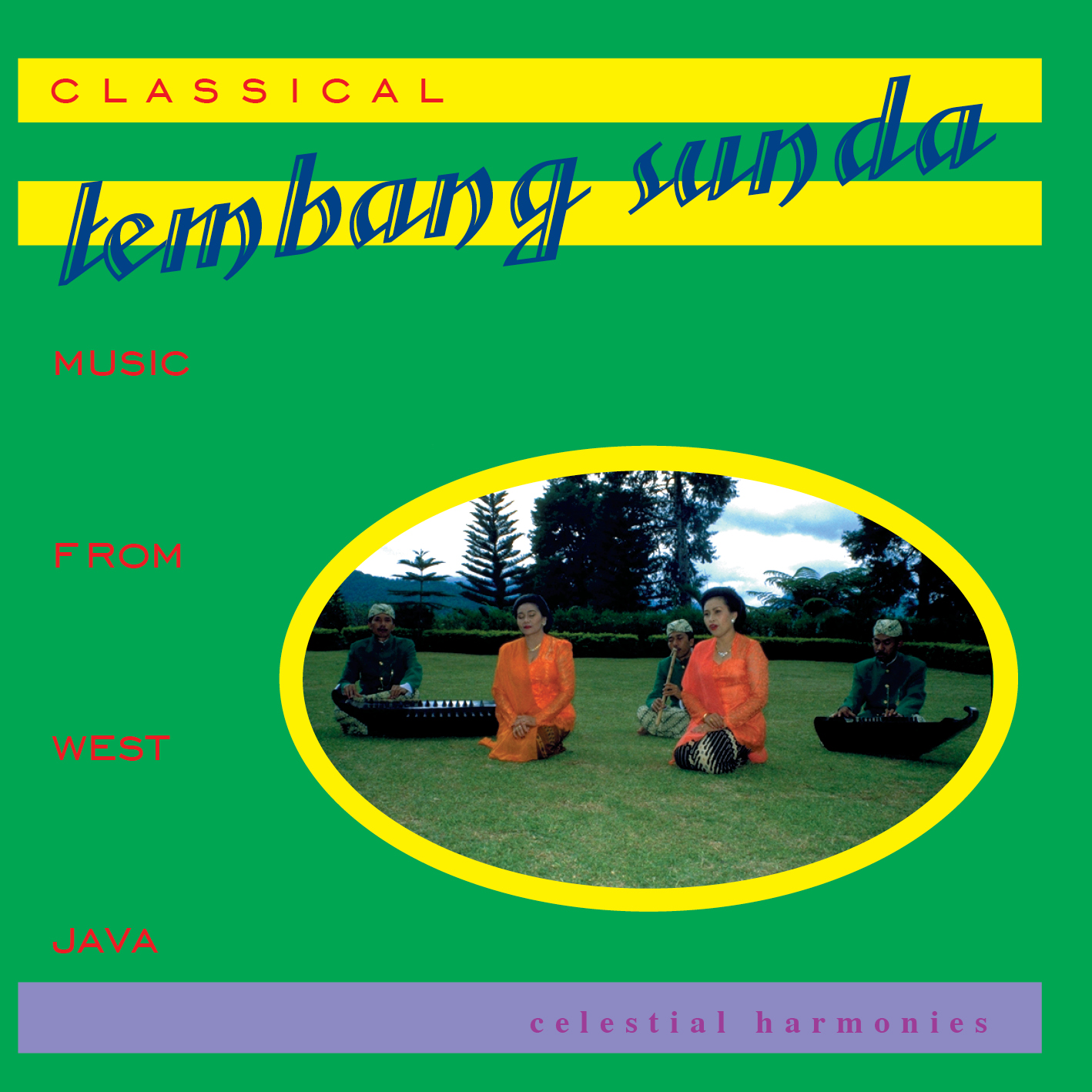
13134 TEMBANG
SUNDA: CLASSICAL MUSIC FROM WEST JAVA - IDA WIDAWATI/LINGKUNG
SENI MALATI
South–East Asia has missed out on the world music bandwagon. Peformers
from China (the Guo Brothers), Tibet (Yungchen Lhamo), Pakistan (Nusrat
Fateh Ali Khan), Tuva (Shu–De) and India have all found international
record deals and enjoyed considerable success on the world music circuit.
But there has been a notable absence of musicians from Cambodia, Thailand,
Vietnam, Malayisa and Indonesia. In part some of the countries are suffering
from pop cultural confusion (Thailand has its own version of the Spice
Girls) and in part the region's angular gamelan–style of percussive
classical music and tonal singing have just been too far removed from
western sensibilities.
It was herefore with surprise that I found that Tembang Sunda,
a collection of classical music from West Java produced by a New Zealand
ambient composer, David Parsons, was not only very accessible but also
extraordinarily delicate and beautiful. The complex rhythms of Indonesian
gamelan give way to gentle, lyrical, slightly Middle Eastern vocals
from Ida Widawati, and the musical backing from the group Lingkung Seni
Malati, is an exotic mixture of zithers (kacapi indung and kacapi rincik),
lutes (rebab) and bamboo flutes (suling).
The result is a collection of pieces with names like Mupu Kembang
(Picking Flowers), Ligar (Flower in Full Blossom) and Angin
Peuting (Evening Breeze).
The titles indicate quite precisely the delicate beauty of the music.
The interplay between Widawati's vocals, the suling and zithers is a
pure delight.
January 12, 1997 (The Guide)

14113 JAMES
JOYCE: FINNEGANS WAKE (2CD) - EXCERPTS READ BY PATRICK
BALL
Does anyone apart from Eng. Lit. academics and linguistic trainspotters
read Finnegans Wake these days? Back in 1960 is was quite de
rigeur to carry a copy around and, when trying to impress, to read a
section and claim you understood it. Yes, it is a richly rewarding exercise.
But, equally, it is like Peter Greenaway's Prospero's Books—better
as a theory than as a reality. Too rich and dense for consumption by
normal means.
This recording by Patrick Ball is an astute compromise and goes quite
a way to making the work accessible. Ball, an Irishman and celtic harpist
now living in the United States, has composed a series of pieces (all
are deeply rooted in Irish traditional music) inspired by sections of
Finnegans Wake. Not surprisingly, there is riverrun (23
minutes of music and reading from the opening pages), Shem (16
minutes from the Shem and Shaun section) and, for more
than half an hour, the glorious Anna Livia Plurabelle. It works
because Finnegans Wake makes sense only when read aloud, because
Ball is a good reader with a soft Irish lilt to his voice, and because
a Celtic harp is ideal accompaniment (it is clean and simple, the text
is complex and rich) for this strange and wonderful novel.
You've got to be a committed Joycean to enjoy this. If you are, you'll
love it.

15019
SHOALHAVEN RISE -
RILEY LEE, MICHAEL ASKILL AND MICHAEL ATHERTON
The product of six glorious days at Arthur Boyd's rustic artistic retreat,
Bundanon, on the Shoalhaven River near Nowra, this is another fascinating
synthesis from three of Australia's most interesting and talented experimental
musicians. From the opening, breathy sounds of Riley Lee's shakuhachi
through to the wonderfully subtle guitar, oud, bouzouki and didgeridoo
playing of Michael Atherton and Michael Askill's always tasteful percussion
fills, this is one of those recording which demonstrates that "atmospheric"
and "ambient" music can be both passionate and intellectually
rigorous.
The musicians have responded to their environment—not only to
the Shoalhaven valley but also to the Boyd crucifixion paintings on
the walls of the music room—and created music that shimmers with
rural beauty. This is music which evokes the tranquility of Bundanon
(the interplay between Lee's shakuhachi, Askill's shaker and Atherton's
guitar on the title track is superb) and which expresses a deep love
of Australia.
I was lucky enough to see most of this remarkably beautiful recording
performed live on the front verandah of Bundanon. Amid the lush lawns
and under a huge magnolia tree, the music seemed so right, so perfectly
in harmony with the surroundings.
The result is a special piece of Australian musical and cultural history
. It is said that when the trio asked Arthur Boyd if he would paint
the cover for the CD he asked: "Do you think I could do it?"
The result is a painting of Boyd's beloved Shoalhaven which perfectly
complements the music.
Tuesday, November 19, 1996 (Arts)
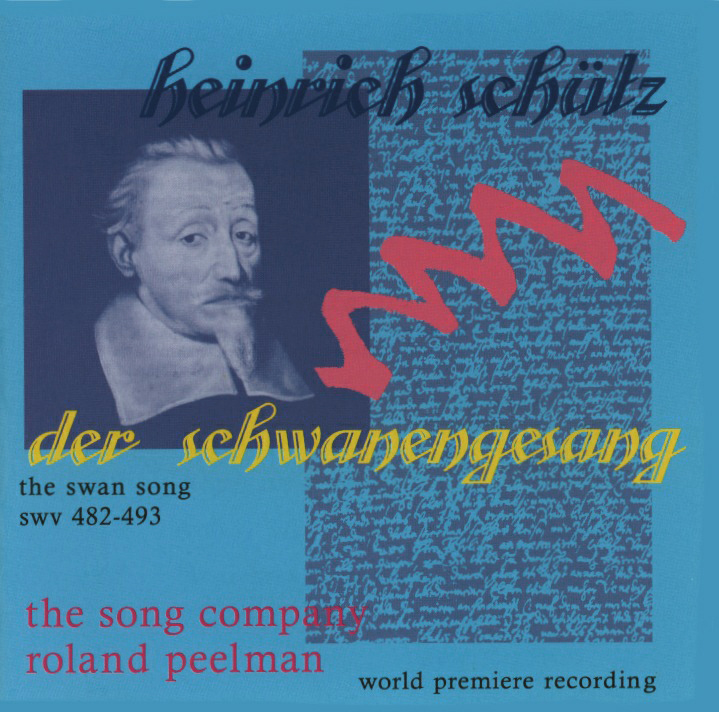
13139 HEINRICH SCHÜTZ DER
SCHWANENGESANG (THE SWAN-SONG) - THE SONG COMPANY,
ROLAND PEELMAN - DIRECTOR
A moving swansong
The Song Company, Schütz's Schwanengesang, St. James,
November 16
Posterity seems to get it right much of the time, with many works falling
into obscurity for good reason. Not so, however, the Schwanengesang
(Swansong) of Heinrich Schütz, who laid the foundations for
baroque music in German–speaking Europe a century before Bach.
The Australian premiere of this work, given by the Song Company, showed
it to be a masterpiece of sorts, a kind of Heilige Deutsche Monteverdi.
It isn't your Classic Drive fare, however. Schütz wrote the piece
as a musical and religious testimony at the end of a very long life,
and thus chose Psalm 119 (the longest) as his text, out of which he
fashioned 11 motets. I infer from Roland Peelman's annotations that
the motets can be used separately for liturgic purposes, given that
each begins with a chanted intonation—appropriately sacerdotal
singing from David McKenzie—and concludes with the doxology. But
as Schütz wrote the pieces as a set, it was interesting to hear
them as such.
Given that any kind of liturgy is foreign to most people's experience
these days, it should be said that to appreciate this music required
meditative patience (and maybe a cushion). It is a work with a stately
time–span and is accordingly a Very Big Sing, for all eight voices.
To their great credit, the singers maintained an impressive level of
stamina throughout the evening with due Protestant decorum—Schütz
avoids any kind of vulgar display. Solo writing for the voices is minimal,
though Ruth Kilpatricks's soprano was allowed moments of great clarity
and David V. Russell's alto was pleasingly prominent in the sixth motet.
On the whole, the music concentrates more on the contrasts of the antiphonally
arranged quartets, and the range of smaller ensembles that this provides.
While the harmonic cross relations occassionally got downright angry,
the blend and the tuning was very good, particularly in the high, close
harmony which was required of the men at times.
Schütz's recurring structural prinicple is to create chordal pillars
which support lintels of polyphonic tracery, in which various devices
of canon and hocket prevail. Every so often the pithy Monteverdian phrase
sounds in Schütz merely short–winded, but on the other hand
the exultant homophony of the end of the fourth motet is truly sublime.
David Drury discreetly accompanied the work on a portative organ that
looks like a medieval cigarette machine, but in his hands can sound
like a flock of low–flying angels. In addition to his careful support
of the singers, Drury played two short solos—one anonymous and
one by Sweelinck—which demonstrate his sure technique and familiarity
with the style.
Schütz's is a very moving summation of a life's work and conviction.
Michael Jackson's I Love You echoed down my street as I got home,
but it didn't ring anywhere as true.
August 5, 1996
15023
LYREBIRD - MATTHEW DOYLE AND MICHAEL ATHERTON
Matthew Doyle is one of this country's most imaginative
and innovative didgeridoo performers. Like David Hudson (from the Tjapukai
Dance Theatre), Alan Dargin and Mark Atkins, he has taken this sacred
instrument and found a way to make its strangely compelling sounds work
on record.
Working with the percussionist/academic Michael Atherton, Doyle has
created a series of soundscapes which range from New Beginning—an
extended piece which seems to evoke the vastness of inland Australia—though
the experimental, minimal sounds of Hand Stencils (with Doyle
getting flute–like sounds out of the didgeridoo) to Cave Drawings
and Mungari.
Doyle, who is also a performer with the Aboriginal Islander Dance
Theatre, brings a sense of living ritual and celebration to the performances
of Mouth Music, Tongue Talk and the beautiful Wiridjiribin:
The First Lyrebird, where his own staccato chants serve as a sharp
counterpoint to the droning sound of the didgeridoo.
This is one of the most successful of all the Aboriginal–Western
musical cross–fertilisations. It works as an authentic expression
of Aboriginal culture and a series of evocative soundscapes.
February 10, 1995
World music warrior
When a producer with the record company Celestial Harmonies suggested
to Vietnamese musicians and government officials that he record their
music in the old imperial palace in Hue, a frisson went through the
assembled group.
"We had been kind enough—the Australians and the Americans—to
bomb that place to smithereens," recalls Eckart Rahn, Tucson (Arizona)–based
owner of the record label, the cringe factor still evident in his voice.
"We know so goddam little about Vietnam, even after our involvement
in the war."
On Gareth Evans's suggestion, the company also went into Cambodia
to record traditional music, during a "window of opportunity"
between the arrival of United Nations peace keepers and the resumption
of Khmer Rouge activity.
Celestial Harmonies is now recording the music of Islam on 12 compact
discs. Work has been done in Morocco, Indonesia, Egypt, Nubia and Tunisia.
Remaining on the schedule are "all the places you don't want to
visit," as Rahn puts it—places such as Iran, Iraq and Sinai,
which most Westerners would approach with trepidation.
Rahn is a sort of Indiana Jones of music recording. His label covers
music from every continent of the world, music which he and a handful
of specialist producers record in situ wherever music is to be
found—regardless of the amenities or the risk.
"You don't even read the alphabet, you're constantly at the mercy
of ethnomusicologists, translators, embassy people," he says, with
apposite enthusiasm. "It's a struggle...But don't get me wrong.
I'm not complaining. It's what I do. And the nice thing is, in three
years I haven't done anything I know anything about."
At 50, Rahn is tall, big-built, and has a restless energy which spills
into his conversation. He admits he loves to talk. A late–riser,
he apparently works equally late into the night, tinkering with ideas,
designing graphics for disc covers, doing detailed research for the
liner notes which he writes.
Other recording executives may talk about units sold and air–time
won. Rahn gets stirred–up evaluating Bill Clinton's non–participation
in the Vietnam war. "Clinton should have been proud to have dodged
the war," he thunders. "The idea of joining the military is
unthinkable for a European intellectual, then and now."
Rahn was born in Germany to a family oblivious to music. His grandfather,
he says, worked for the railway and only listened to the radio for the
news. His mother was a convert to Catholicism and Eckart was dragged
unwillingly to Church. "It has taken me till I was 50 to make an
organ recording with compassion," he says.
He discovered music when he was 15. "I walked past a record store
and be–bop wafted out. I was a different person after that."
Coming to maturity in the radical '60s, Rahn produced political rock
in Berlin and Hamburg and eventually founded his own independent record
label. He was attracted to the energy of the anti–war protest in
the United States and moved there in 1972.
He coined the English title for his now–American company in 1976
and started manufacturing in 1980. "We had these quiet recordings
in an age of mega–rock. You could only be talked to in the record
business after you had done 30 million units," he recalls. "That
changed rapidly in the early '80s. You could make more money out of
CDs then and that led to the incredible growth of independent record
companies."
He remains idealistic and is confident no–one could accuse him
of selling out. Although he has made money in the "last dozen years",
he says, he has only changed his lifestyle to book into better hotels
when he travels on business.
Rahn is evangelical about the importance of cultural exchange. "What
we recorded in Phnom Penh and Angkor Wat is mostly unknown to outsiders
and to Cambodians. In the absence of media infrastructure as we know
it in the West, if you didn't live there and hear it performed, you
would not hear it at all," he says. "Now you can get a boxed
set in Sydney."
Challenged about the appropriateness of Westerners recording the traditional
music of other peoples for sale in the West, Rahn remains unphased.
"I'm not going to Cambodia to colonise them culturally,"
he says. "No–one is forcing them to play and the musicians
are paid fairly. When the New York Philharmonic plays in Asia, are the
Chinese ripping off Beethoven?
To be a true liberal, you have to be in favor of the exchange of culture
in both directions. Sometimes we have a missionary zeal to bring it
to the heathen, but to take from the heathen is considered not so good."
His criterion for appropriateness, he says, is respect.
"Firstly, we're bringing the same quality of sound recording to
Angkor Wat as we would to Berlin," he says. "And then there's
the extent and quality of annotation. We [produce] booklets of as much
as 44 pages and we go to enormous lengths to verify spelling, the proper
transliteration of alphabets, and proofreading. Everything we do is
subject to the scrutiny of ethnomusicologists , embassies, cultural
ministries, the United Nations. Often getting the booklets done [takes]
more time than the recording."
He points out that the term "ethnomusicology" is inherently
derogatory and paints a multicultural fantasy of a musicologist dealing
with Islamic music while an ethnomusicologist "sits in India looking
into the weird psychological aspects of late 19th century Austrian music
through the work of Mahler." He also believes that technology will
soon allow Third World intellectuals and enthusiasts easy access to
music.
Rahn is also evangelical about the environment. His awakening came
when he re-recorded Paul Horn playing flute at the Taj Mahal in 1989,
23 years after an original recording. "The whole place was falling
apart, all blackened from industrial fumes, and there were too many
tourists," he says.
In 1992, the notion simply struck him that trees shouldn't be cut down
to make CD booklets, and he began using recycled paper. "Then in
the Gulf War, I thought it was downright stupid to go to war to preserve
the oil supply which [we] should try to learn to live without. So making
these somewhat ridiculous CD containers didn't make sense."
New Celestial Harmonies CDs are packaged in recyclable plastic. A new
design, in which the tray is removed and the covers modified, allows
two CDs to be packaged in a single slim–line box. All printing
is done with non–toxic vegetable inks.
Rahn has had increasing contact with Australia since 1989, and now
spends three to four months here every year. He has signed up the Australian
percussion group Synergy, the acoustic trio Coolangubra and the didgeridoo
player David Hudson.
He has also been embroiled for the past two years in a running battle
to wrest 150 minutes of traditional Aboriginal music from the vaults
of the Australian Institute of Aboriginal and Torres Strait Islander
Studies (AITSIS) in Canberra. The original plan was to release the music
on a non–exclusive license, with a large booklet containing descriptive
text, accompanied by 30 or 40 images of Aboriginal art housed in the
National Gallery of Australia.
He had fruitful discussions with the gallery's Aboriginal art curator.
Rahn says he offered to pay for the music, pay copyright royalties where
appropriate, pay for a researcher to work with AITSIS for six months,
and to keep away from sacred music. The material, now recorded on analogue
media, would be converted to long–lasting digitally recorded disc.
Furthermore, he says, his record on cultural and religious sensitivity
speaks for itself.
According to Rahn's notes, the AITSIS argument revolves around the
sacred nature of much of the music and the physical integrity of the
tapes they hold.
Rahn, as one could imagine, has not given up yet.
|